CAR magazine • 25 July 2017
Juicy steering, a well-finished interior and all-out pace are three strong pillars that make this car a joy to drive no matter the time or season.
2017 Porsche Macan Review: The average edition of a stellar SUV • 17 April 2017
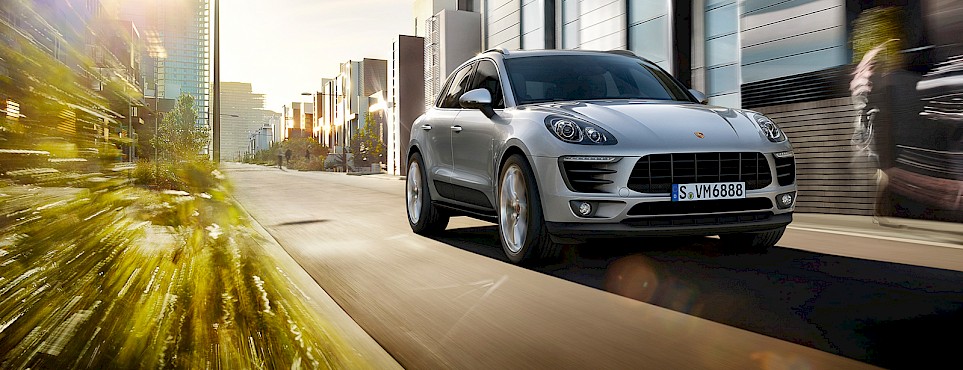
Porsche does not often, if ever, build lackluster vehicles. Rather, its stock in trade are automobiles that catch your eye just before their power makes you stop to catch your breath. Consider, then, the exception that is the new-for-2017 base model Porsche Macan, the entry-level follow-up to the outstanding Macan S, GTS, and Macan Turbo trio that have dazzled since first introduced a mere two years ago. Now equipped with a turbocharged four-cylinder motor in place of the turbo six found in its siblings, the most affordable Macan makes a clear trade: scintillating performance for mass market appeal. Volume sales are the lifeblood of any automaker seeking to rise above niche status, and Porsche has done a commendable job in courting bigger numbers by way of the larger Cayenne SUV, the Panamera sedan, and the previous versions of the Macan. Each of these models, while stepping far outside the lines penciled in by the brand-defining 911 sports car, are titans of speed and handling in their respective classes, and have found an enormous audience. The four-cylinder Macan is something a little different. Luxury brands always have access to one simple strategy when it comes to tapping into the unreserved lust for the prestige associated with their image, and that’s lowering the price of their offerings to the point where the badge is within reach of a new segment of the market. To do this, however, often means stripping down part of the package being offered, to both protect the reputation of pricier models and, more practically, to keep profits healthy. It’s this strategy that has guided the development of the 2017 Porsche Macan (no S, no Turbo, just Macan on the rear deck), a vehicle that for all intents and purposes matches the Macan S for equipment everywhere but in the engine bay. For the latter, the drop-off is precipitous: in place of the 340 horsepower, 3.0-liter turbocharged V6, there’s now a 2.0-liter turbocharged four-cylinder that’s good for 252 ponies. Torque is also down, although not by as much, with the four-cylinder’s 273 lb-ft showing as 66 lb-ft lower than the Macan S. The rest of the package remains identical, save for a few visual cues and slightly smaller (and somewhat mushy) brakes. This means that the suspension tune, seven-speed dual-clutch automated manual transmission, and all-wheel drive in the Macan are a match for that of the Macan S, and indeed, the base model feels as firmly sprung over rough roads as its mightier showroom companion does. Handling for the Porsche is a cut above almost everything else on offer in its class, trouncing the Audi Q5 and the BMW X3, with only the Jaguar F-Pace delivering a similar mix of sharp reflexes and pleasing cruising comfort. Get into the throttle hard, however, and it’s more difficult to sing the Macan’s praises. Acceleration – both off the line and on the highway – is average at best, perfectly acceptable for the vehicle’s $47,800 price point but a far cry from the ‘wow, is this really happening in an SUV?’ sensation delivered by the V6 in the Macan S. Perhaps it’s because I was so wowed by the S experience (which in turn is bested by both the Macan GTS’ 360 horsepower and the Macan Turbo’s 3.6-liter, 400 horsepower mill) that the four-cylinder felt like such a let-down. Trying to move just under 4,000 lbs with a pair of cylinders missing also likely had something to do with it, and although the engine feels somewhat livelier when the vehicle’s driving mode is set to Sport+, you’re still hovering just over six seconds for the sprint to 60-mph. Expectations can greatly affect one’s impression of anything, and such was the case during my time with the Porsche Macan. The turbo four did everything I asked it to do – transported a relatively large load of gear on a long highway trip with surprisingly little hassle, handled nasty spring weather with aplomb, caught the eye of would-be Porsche owners window-shopping through their windshields – but at no point did it put a smile on my face. This was a stark contrast to Macan S, which regularly had me shaking my head in disbelief at just how outstanding its drivetrain felt in nearly every driving situation. It’s also worth noting that the tester I drove was a very low-option model, which a rarity in the Porsche world. Outfitted with 19-inch wheels and the Sport Chrono package (launch control, the previously-mentioned Sport Plus driving mode for quicker shifts and more aggressive throttle tip-in), the Macan still featured a respectable level of standard gear, including a power tailgate, a rearview camera, a lane departure warning system, leather seats, Apple CarPlay, surround sound audio, and three zones of automatic climate control. Still, there are a few absences that will need to be addressed (keyless entry, sunroof, navigation) and if you want more, there’s plenty to be had on the order sheet, where it’s easy to drop $15,000 on extra gear if you’re not careful. That the new 2017 Porsche Macan will be a smash hit is almost certain, with an early sales mix indicating nearly 40 percent of customers opting for the turbo four. Its combination of attractive pricing, brand prestige, and excellent handling make it a compelling choice when facing off against less expensive, but more subdued European and Japanese luxury fare. It also proves that performance as a concept is important to premium SUV shoppers, but not necessarily on an individual, product-by-product basis, as long as some of that shine rubs off on the ride home. Is it the Macan you should buy? If you care about bridging the gap from good to great, I’d say it’s well worth it to kick in the extra $7k or so it takes to get behind the wheel of the much more interesting Macan S. Let’s be honest – you’re not leaving the dealership with anything short of a $60,000 hole in your pocket once you’ve got the SUV configured to your liking. Earmark a sizable chunk of that lump sum for the engine and you’ll amplify your enjoyment behind the wheel by an order of magnitude.
Bäst och sämst fyrhjulsdrift • 27 January 2017
Fyrhjulsdrivna bilar säljer som aldrig förr. Men vilka system för fyrhjulsdrift är bäst och vilka är sämst? Det har vi testat.
Auto Express • 20 December 2016
Performance add-ons for the Porsche Macan Turbo make this SUV a Turbo S in all but the name...
2017 Porsche Macan GTS takes on two peaks in one day • 30 July 2016
It’s track time and Pikes Peak Hill Climb is no ordinary race track. Taking a corner too wide pretty much anywhere within the 14,114 climb along what’s a 12.42 mile course packed with 156 twists and turns has consequences beyond a couple of dents. Luckily, Porsche’s confidence in the new 2017 Macan GTS is off the chart. This is a super rare opportunity where automotive journalists were given the opportunity to drive up Pikes Peaks and then, on the very same day, keep on going right up Mount Evans. At this high of an altitude both the Macan GTS’s horsepower as well as the human body starts to feel the affects. Luckily our convoy of SUVs blazed through the drive with flying colors – no mid-trip shortcuts off the edge of the mountain – and the mighty middle-child Macan’s performance proved stellar. Back when I tried the new Macan for the first time, I solicited three different driving instructors as to whether they’d pick the cheaper Macan S over its Turbo sibling, and unanimously they opted for the S (albeit with the caveat that the air suspension, PASM and PTV Plus and Sport Chrono Package ($1,800) options were all ticked, too). Comparing the standard-fit tech on the Macan GTS with their “perfect spec”, I see plenty of familiar features. The 7-speed PDK dual-clutch transmission is there, as is the air suspension with Porsche Adaptive Suspension Management (PASM). You might think rowing your own gears on a challenging course like the Hill Climb would be preferable, but I tried to manually paddle-shift to see if I could best the seven-speed PDK dual-clutch transmission but, on such challenging terrain, my reactions proved no match for the near-telepathic shifter. Porsche has re-tuned the air suspension so that the Macan GTS can reduce its ride height by up to approximately 10-millimeters, which improved the center of gravity for our spirited drive up the mountain. While the SUV doesn’t get the Turbo’s 3.6-liter with 400-hp and 406 lb-ft, it does however get a 20 hp bump from the S’s 3.0-liter twin-turbocharged V6 engine yielding 360-hp and 369 lb-ft. At $372-per-hp, that’s $7,440 in savings. Keeping in mind that Porsche named the subcompact SUV after a tiger in Indonesia, I felt confident pushing the GTS to the best of my driving abilities to follow Pikes Peak Legend, Jeff Zwart. It’s a course he’s raced multiple times and won in several different classifications, and proved more than capable of leading a pack of speeding tigers through the valley and ridges. The GTS isn’t screaming fast like the Turbo but it’s the most driver-centric of the Macan trio. Most importantly for something like Pikes Peak, having an engine with a midrange between 3000 and 5500 rpm is ideal for the task at hand. Heading into a hard turn, I’d paddle shift down to the lowest possible gear which was often second, slamming on the brake moments prior and then immediately back on the gas after the apex. Hitting third gear propels the Macan past 60+ mph, and that’s two or three times the 20-mph speed limit. Whether I paddle-shifted or let the PDK do all the work, it was near-instantaneous. That’s more than any driver can ask for on such a demanding road course. Having driven the S and Turbo variants, I knew coming in that I had to commit to treating the Mecan as a sports car in SUV’s clothing – Porsche maintains it has the ‘heart and soul’ of a sports car – and I wasn’t disappointed. After a couple of crackles over the walkie-talkie, Jeff announced “we’re off” and, with immediate urgency, the five Macan convoy ascended Pikes Peak. There’s little room for error navigating the 4,200-pound beast; let your focus drift for just a few seconds and, at best, you can lose time by slipping off Zwart’s racing line. At worst, you could slip right off the mountain. About a third of the way up, I found myself regretting my decision to give up the slot right behind his lead car, but I could still do my best to ignore the Macan ahead and focus on Jeff’s racing lines. Still plenty of visibility for the epic moment when Jeff took an ultra-wide left before slicing immediately into a sharp right – and leaving one whole rear rear wheel completely off the edge of the cliff in the process. Did I mention that the majority of the hill climb lacks any sort of guardrail and, when combined with unexpected corners, things can quickly go south (no pun intended)? At the time I thought something along the lines of “holy crap, did that just happen?” It was only later that a colleague following behind me told me half of my own rear tire was also off the cliff. That’s 10-inches of the 20-inch Michelin Latitude all-season tires. To the car’s credit, the handling’s better than stellar. Although it’s an all-wheel-drive system, most of the power is transferred to the rear so it turns in and straightens out as a proper Porsche should, elegantly gliding from turn to turn gracefully. It’s courtesy of the excellent stability control, the optional torque vectoring system, and large 14.2-inch front disc brakes with six-piston fixed red calipers and 13-inch single-piston rear red calipers. On a drive such as this one, it probably won’t surprise you when I say that great brakes are pretty critical. Happily, they did a fine job keeping me from running off the cliff. While the Macan doesn’t drive like a 911 – and nor, frankly, would I expect it to – the new power steering has an improved electric assist motor. Unlike the previous Macan S and turbo I drove at launch, there’s more feedback and that’s a must-have. The weather was unpredictable so Porsche erred on the safe side with Pirelli Scorpion all-season tires on 20-inch wheels, the standard-fit. If you’re not of a mind to tackle a legendary hill-climb, though, 19s and 21-inch wheels, along with summer/stickier tires are available. It had all been going so well; then, at roughly 12,400-feet up, luck ran out. The high altitude had lowered the boiling point of the car’s coolant, spewing off a crazy cloud of steam. Pair that with a snapped belt and I was forced to pull over. Hindsight being 20/20, I should’ve just said “what the hell, I’m making it to the peak no matter what!” Unfortunately, at the time I wasn’t sure if it were the brakes that were failing so I didn’t want to risk mine and my co-driver’s life. Porsche later confirmed my suspicions that there was no actual damage to the engine: the belt was swapped out, the fluid – which has hosed out the engine compartment – topped up, and the car was back in action a few hours later. It’s important to note that these were pre-production vehicles; any frustration at a prematurely curtailed trip is a small price to pay for being Porsche’s product development test drivers. Looking at the liveries on the GTS we drove, you can’t really see the standard Macan GTS treatment. Each of our GTS were wrapped like Porsche’s past Pikes Peak race cars – I’d be happy to sport any of them if I’d bought a GTS or any of the Porsche line up for that matter. As standard, the exterior gets black wheels, matte and gloss accents throughout – such as the lower door panels – and a long list of ways for you to make it your own courtesy of the options list. Pricing starts at $68,250 though most owners, according to Porsche, will an an average of $20,000 in options. That being said, expect to pay in the mid $80k range for a Macan GTS. Putting it into perspective, that’s still well below the $100k+ price tag for the Macan turbo. The Porsche Macan is my benchmark for every and all subcompact SUV. While it’s much more expensive than most of the cars in the segment, you see where your money goes: it’s one of the best in every respect. In new GTS form it both looks and drives like a proper Porsche, and thanks to that the price tag matches.